
Bacterial Gene Expression Technologies - Merna Abou-Selima,Mahmoud Zaky
-35% koodilla BOOKS
Toimitus 12-18 arkipäivässä
30 päivän palautusoikeus
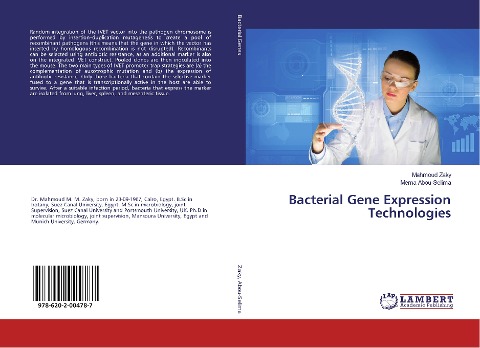
Random integration of the IVET vector into the pathogen chromosome is performed by insertion¿duplication mutagenesis to create a pool of recombinant pathogens (this means that the gene in which the vector has inserted by homologous recombination is not disrupted). Recombinants can be selected using antibiotic resistance, as an additional marker is also on the integrated IVET construct. Pooled clones are the ... Täydellinen kuvaus
Saatat myös pitää
 TOP
TOP

Determined: The Science of Life Without Free Will
-35% koodilla BOOKS
Toimittajalla varastossa
TOP

The Light Eaters: How the Unseen World of Plant Intelligence Offers a New Understanding of Life on Earth
-35% koodilla BOOKS
Toimittajalla varastossa
 TOP
TOP
Why We Sleep: Unlocking the Power of Sleep and Dreams
-35% koodilla BOOKS
Varastossa
TOP
The Rise and Fall of the Dinosaurs: A New History of a Lost World
-35% koodilla BOOKS
Toimittajalla varastossa
TOP

Biology: A Global Approach, Global Edition
Neil Campbell, Rebecca Orr, Lisa Urry, Peter Minorsky, Michael Cain, Jane Reece, Steven Wasserman
-35% koodilla BOOKS
Toimittajalla varastossa
TOP

Six Not-so-easy Pieces: Einstein's Relativity, Symmetry, and Space-Time
Richard P. Feynman, Robert B. Leighton, Matthew Sands
-35% koodilla BOOKS
Toimittajalla varastossa
TOP

Explaining AuDHD: The expert-led guide to Autism and ADHD Co-concurrence
-35% koodilla BOOKS
Toimittajalla varastossa
TOP


The Age of Alchemy: How Early Innovators Shaped Modern Chemistry
-35% koodilla BOOKS
Toimittajalla varastossa
TOP
The Secrets of our DNA: How Genetics has Changed the World
-35% koodilla BOOKS
Toimittajalla varastossa
TOP

How to Solve it: A New Aspect of Mathematical Method
-35% koodilla BOOKS
Toimittajalla varastossa
TOP

Factfulness: Ten Reasons We're Wrong About the World--and Why Things Are Better Than You Think
Ola Rosling, Anna Rosling Rönnlund, Hans Rosling
-35% koodilla BOOKS
Toimittajalla varastossa
TOP
Why Machines Learn: The Elegant Maths Behind Modern AI
-35% koodilla BOOKS
Toimittajalla varastossa
TOP

Seven Brief Lessons on Physics
-35% koodilla BOOKS
Toimittajalla varastossa
TOP

Entangled Life: How Fungi Make Our Worlds, Change Our Minds and Shape Our Futures
-35% koodilla BOOKS
Toimittajalla varastossa
TOP

Life As No One Knows It: The Physics of Life's Emergence
-35% koodilla BOOKS
Toimittajalla varastossa
TOP
The Rise and Reign of the Mammals: A New History, from the Shadow of the Dinosaurs to Us
-35% koodilla BOOKS
Toimittajalla varastossa
TOP
Learn Faster, Perform Better: A Musician's Guide to the Neuroscience of Practicing
-35% koodilla BOOKS
Toimittajalla varastossa
TOP

Janeway's Immunobiology
Leslie J. Berg, Kenneth Murphy, Casey Weaver
-35% koodilla BOOKS
Toimittajalla varastossa
TOP

The Road to Reality: A Complete Guide to the Laws of the Universe
-35% koodilla BOOKS
Toimittajalla varastossa
Kuvaus
Random integration of the IVET vector into the pathogen chromosome is performed by insertion¿duplication mutagenesis to create a pool of recombinant pathogens (this means that the gene in which the vector has inserted by homologous recombination is not disrupted). Recombinants can be selected using antibiotic resistance, as an additional marker is also on the integrated IVET construct. Pooled clones are then inoculated into the mouse. The two main types of IVET promoter trap strategies are (a) the complementation of auxotrophic mutation and (b) the expression of antibiotic resistance. Only those bacteria that contain the selective marker fused to a gene that is transcriptionally active in the host are able to survive. After a suitable infection period, bacteria that express the marker are isolated from lung, liver, spleen, and mesenteric tissue.
Lisätietoja
| Kirjoittaja | Merna Abou-Selima, Mahmoud Zaky |
|---|---|
| Julkaisija | LAP LAMBERT Academic Publishing |
| Julkaisuvuosi | 2017 |
| Kannen tyyppi | Pehmeäkantinen |
| EAN | 9786202004787 |