
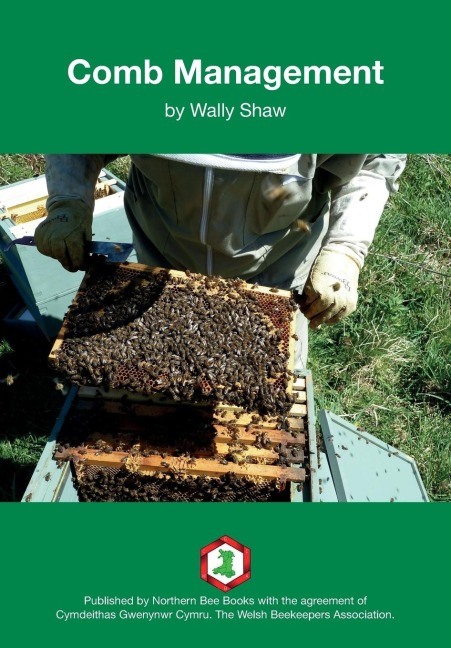
Comb Management - Wally Shaw
-35% koodilla BOOKS
Toimitus 10-16 arkipäivässä
30 päivän palautusoikeus
Honey bees can successfully live in all sorts of different nest sites - a hole in a tree, a chimney pot or a bee-hive - but in all cases this is just a cavity in which to make a set of combs. It is in and on these combs that all the within the colony functions occur. Because it is dark in the hive, communication is through pheromones or vibration and combs provide the ideal carrier for this information. For ... Täydellinen kuvaus
Saatat myös pitää

 TOP
TOP

INCOSE Systems Engineering Handbook
-35% koodilla BOOKS
Toimittajalla varastossa
TOP

If Anyone Builds It, Everyone Dies: The Case Against Superintelligent AI
Eliezer Yudkowsky, Nate Soares
-35% koodilla BOOKS
Toimittajalla varastossa
 TOP
TOP

Open Circuits: The Inner Beauty of Electronic Components
Eric Schlaepfer, Windell Oskay
-35% koodilla BOOKS
Toimittajalla varastossa
TOP

Get started with MicroPython on Raspberry Pi Pico: The Official Raspberry Pi Pico Guide
-35% koodilla BOOKS
Toimittajalla varastossa
TOP


We Are Not Machines: The Fight for the Future of Work
-35% koodilla BOOKS
Toimittajalla varastossa
TOP

Foundations of Flavor: The Noma Guide to Fermentation: Including Step-By-Step Information on Making and Cooking with: Koji, Kombuchas, Shoyus, Misos, Vinegars, Garums, Lacto-Ferments and black Fruits Vegetables
-35% koodilla BOOKS
Toimittajalla varastossa
TOP

Nucleo Boards Programming with the STM32CubeIDE: Hands-on in more than 50 projects
-35% koodilla BOOKS
Toimittajalla varastossa
TOP

Data-Driven Science and Engineering: Machine Learning, Dynamical Systems, and Control
Steven L. Brunton, J. Nathan Kutz
-35% koodilla BOOKS
Toimittajalla varastossa
TOP

Black Holes: The Key to Understanding the Universe
-35% koodilla BOOKS
Toimittajalla varastossa
TOP

Practical Electronics for Inventors
-35% koodilla BOOKS
Toimittajalla varastossa
TOP

Flowers For Algernon: A Modern Literary Classic
-35% koodilla BOOKS
Toimittajalla varastossa
TOP

Human Compatible: Artificial Intelligence and the Problem of Control
-35% koodilla BOOKS
Toimittajalla varastossa
TOP

How To Read Water: Clues & Patterns from Puddles to the Sea
-35% koodilla BOOKS
Toimittajalla varastossa
TOP

Make: Electronics: Learning by Discovery: A hands-on primer for the new electronics enthusiast
-35% koodilla BOOKS
Toimittajalla varastossa
TOP

Mastering the Arduino Uno R4: Programming and Projects for the Minima and WiFi
-35% koodilla BOOKS
Toimittajalla varastossa
TOP

The Idea Factory: Bell Labs and the Great Age of American Innovation
-35% koodilla BOOKS
Toimittajalla varastossa
TOP

Fundamentals of Aerodynamics ISE
Christopher Cadou, John D. Anderson
-35% koodilla BOOKS
Toimittajalla varastossa
TOP

Foundation Design and Construction
-35% koodilla BOOKS
Toimittajalla varastossa
Kuvaus
Honey bees can successfully live in all sorts of different nest sites - a hole in a tree, a chimney pot or a bee-hive - but in all cases this is just a cavity in which to make a set of combs. It is in and on these combs that all the within the colony functions occur. Because it is dark in the hive, communication is through pheromones or vibration and combs provide the ideal carrier for this information. For example, bees can always locate the queen by following the trail of her footprint pheromone on the combs. The main outside the hive activities are foraging, swarming and queen mating. As beekeepers, interested in the production of honey, we tend to concentrate on the foraging activities of our bees and it is easy to overlook the fact that over 95% of a typical worker bee's life is spent within the confines of the colony engaged in some activity in or on the combs. In a sense, the combs are an extension of the bees that made them and it is bees and combs together that constitute the colony. Up until about 1850, bee colonies, whether wild of under human stewardship (it hardly qualified as management), built themselves a set of combs entirely according to their own design in whatever cavity they could find or was provided by the beekeeper. No restriction was placed on the way the colony used these combs to engage in their main activities of brood rearing and food storage. With the introduction of the moveable frame hive, followed quickly by the invention of wax foundation and the queen excluder, everything changed. Beekeepers were now able to induce the bees to make their combs where they (the beekeepers) wanted them, ie in wooden frames. The beekeeper could now even influence the size of cells they built by the dimensions of the hexagon embossed on the sheet of wax. It also became possible to separate the use of combs for brood rearing and honey storage using a queen excluder. Some of the changes that modern beekeeping has imposed on colonies have potential effects on the health and welfare of the bees and others do not.
Lisätietoja
| Kirjoittaja | Wally Shaw |
|---|---|
| Julkaisija | Northern Bee Books |
| Julkaisuvuosi | 2018 |
| Kannen tyyppi | Pehmeäkantinen |
| EAN | 9781912271351 |