
Complex Systems and Self-organization Modelling -
-35% koodilla BOOKS
Toimitus 17-23 arkipäivässä
30 päivän palautusoikeus
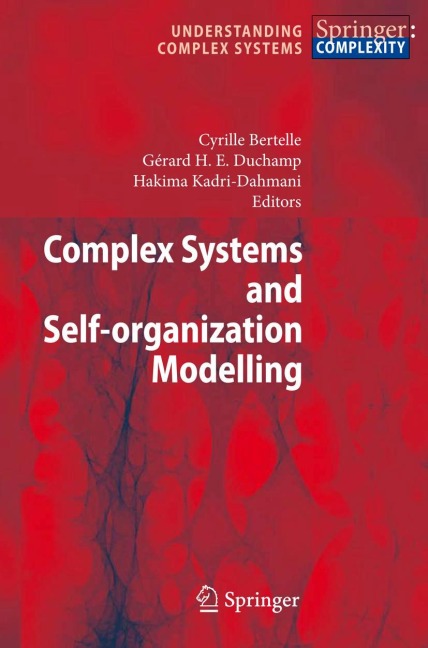
Theconcernofthisbookistheuseofemergentcomputingandself-organization modellingwithinvariousapplicationsofcomplexsystems. Wefocusouratt- tion both on the innovative concepts and implementations in order to model self-organizations, but also on the relevant applicative domains in which they can be used e?ciently. First part deals with general modelling and methodology as conceptual - proaches for complex syste ... Täydellinen kuvaus
Saatat myös pitää
 TOP
TOP

The Demon-Haunted World: Science as a Candle in the Dark
-35% koodilla BOOKS
Toimittajalla varastossa
TOP

The Art of Uncertainty: How to Navigate Chance, Ignorance, Risk and Luck
-35% koodilla BOOKS
Loppu
TOP

Heart Rate Variability: Science and Strategies for Peak Performance
Marco Altini, Sylvain Laborde, Dan Plews, Emma Mosley
-35% koodilla BOOKS
Loppu
TOP

Many Faces, One Purpose: A Manager's Handbook on Women in Firefighting
U. S. Fire Administration, Homeland Security
-35% koodilla BOOKS
Loppu
TOP

Thinking in Systems: International Bestseller
-35% koodilla BOOKS
Toimittajalla varastossa
TOP

The Gulf Moment: Arab Relations Since 2011
Florence Gaub, U. S. Army War College, Strategic Studies Institute
-35% koodilla BOOKS
Loppu
 TOP
TOP

Introduction to Algorithms
Ronald L. Rivest, Charles E. Leiserson, Clifford Stein, Thomas H. Cormen
-35% koodilla BOOKS
Toimittajalla varastossa
TOP

Skin in the Game: Hidden Asymmetries in Daily Life
-35% koodilla BOOKS
Toimittajalla varastossa
TOP

101 Things I Learned in Architecture School
-35% koodilla BOOKS
Toimittajalla varastossa
TOP

Dinosaurs and Prehistoric Life: The Definitive Visual Guide to Prehistoric Animals
-35% koodilla BOOKS
Toimittajalla varastossa
TOP

Worth Dying For: The Power and Politics of Flags
-35% koodilla BOOKS
Toimittajalla varastossa
TOP


Crossing Borders: About the birth of the Consortium of European Research Libraries, the organisation's early years and its path to maturity, spanning the period from the late twentieth century to the first decades of the twenty-first century
-35% koodilla BOOKS
Toimittajalla varastossa
TOP

The Code Book: The Science of Secrecy from Ancient Egypt to Quantum Cryptography
-35% koodilla BOOKS
Toimittajalla varastossa
 TOP
TOP

Only Dull People Are Brilliant at Breakfast
-35% koodilla BOOKS
Toimittajalla varastossa
TOP

Playing It by the Book: Printed and Manuscript Book Games in Early Modern Europe
-35% koodilla BOOKS
Toimittajalla varastossa
TOP

International Economics: Theory and Policy, Global Edition
Paul Krugman, Maurice Obstfeld, Marc Melitz
-35% koodilla BOOKS
Toimittajalla varastossa
TOP

The Dictionary of Obscure Sorrows
-35% koodilla BOOKS
Toimittajalla varastossa
TOP
The Unaccountability Machine: Why Big Systems Make Terrible Decisions
-35% koodilla BOOKS
Toimittajalla varastossa
Kuvaus
Theconcernofthisbookistheuseofemergentcomputingandself-organization modellingwithinvariousapplicationsofcomplexsystems. Wefocusouratt- tion both on the innovative concepts and implementations in order to model self-organizations, but also on the relevant applicative domains in which they can be used e?ciently. First part deals with general modelling and methodology as conceptual - proaches for complex systems description. An introductive chapter by Michel Cotsaftis entitled ¿A Passage to Complex Systems¿, treats the notion of ¿Complex Systems¿ in opposition to that of a ¿Complicated System¿. This can be, he claims, comprehended immediately from the latin roots as ¿C- plex¿ comes from ¿cum plexus¿ (tied up with) whereas ¿complicated¿ ori- natesfrom¿cumpliare¿(piledupwith). Thepaperisawideandrichdisser- tion with elements of history (of the technical developement of mankind) with its recents steps : mechanist, quantum and relativistic points of view. Then, the need for a ¿passage¿ is illustrated by the discussion, with tools borrowed from functional analysis, of a typical parametric di?erential system. The last and conclusive parts give tracks for the study of Complex Systems, in parti- lar one can hope to pass to quantitative study and control of complex systems even if one has to consent a ¿larger intelligence delegation¿ to them (as - nounced in the introduction) by using and developing tools already present in dissipative Physics and in Mathematical functional analysis and ?xed point theorems, for instance. This ¿passage¿ is followed by a wide bibliography of more than 90 entries. The (non hasty) reader is invited to read this deep and far reaching account before browsing through the book.
Lisätietoja
| Julkaisija | Springer Berlin Heidelberg |
|---|---|
| Series | Understanding Complex Systems |
| Julkaisuvuosi | 2009 |
| Kannen tyyppi | Kovakantinen |
| EAN | 9783540880721 |