
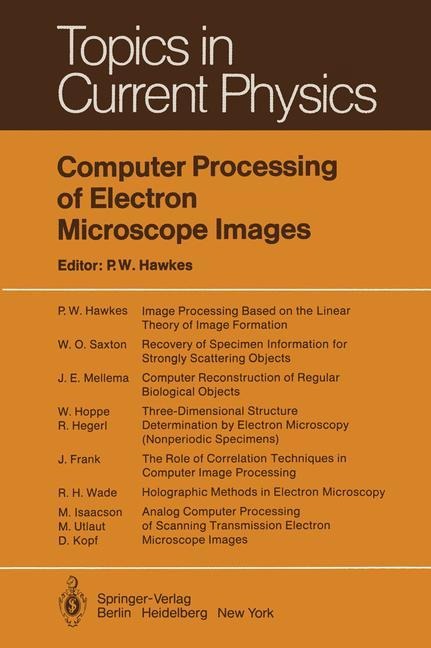
Computer Processing of Electron Microscope Images -
-25% koodilla BOOKS
Toimitus 12-18 arkipäivässä
30 päivän palautusoikeus
Towards the end of the 1960s, a number of quite different circumstances combined to launch a period of intense activity in the digital processing of electron micro graphs. First, many years of work on correcting the resolution-limiting aberrations of electron microscope objectives had shown that these optical impediments to very high resolution could indeed be overcome, but only at the cost of immense expe ... Täydellinen kuvaus
Saatat myös pitää
 TOP
TOP

The Demon-Haunted World: Science as a Candle in the Dark
-25% koodilla BOOKS
Toimittajalla varastossa
TOP

The Art of Uncertainty: How to Navigate Chance, Ignorance, Risk and Luck
-25% koodilla BOOKS
Loppu
TOP

Heart Rate Variability: Science and Strategies for Peak Performance
Marco Altini, Sylvain Laborde, Dan Plews, Emma Mosley
-25% koodilla BOOKS
Loppu
TOP

Many Faces, One Purpose: A Manager's Handbook on Women in Firefighting
U. S. Fire Administration, Homeland Security
-25% koodilla BOOKS
Loppu
TOP

The Gulf Moment: Arab Relations Since 2011
Florence Gaub, U. S. Army War College, Strategic Studies Institute
-25% koodilla BOOKS
Loppu
 TOP
TOP

Introduction to Algorithms
Ronald L. Rivest, Charles E. Leiserson, Clifford Stein, Thomas H. Cormen
-25% koodilla BOOKS
Toimittajalla varastossa
TOP
Thinking in Systems: International Bestseller
-25% koodilla BOOKS
Toimittajalla varastossa
TOP

Skin in the Game: Hidden Asymmetries in Daily Life
-25% koodilla BOOKS
Toimittajalla varastossa
TOP

101 Things I Learned in Architecture School
-25% koodilla BOOKS
Toimittajalla varastossa
TOP

Dinosaurs and Prehistoric Life: The Definitive Visual Guide to Prehistoric Animals
-25% koodilla BOOKS
Toimittajalla varastossa
TOP


Crossing Borders: About the birth of the Consortium of European Research Libraries, the organisation's early years and its path to maturity, spanning the period from the late twentieth century to the first decades of the twenty-first century
-25% koodilla BOOKS
Toimittajalla varastossa
TOP

The Code Book: The Science of Secrecy from Ancient Egypt to Quantum Cryptography
-25% koodilla BOOKS
Toimittajalla varastossa
 TOP
TOP

Worth Dying For: The Power and Politics of Flags
-25% koodilla BOOKS
Toimittajalla varastossa
TOP

Only Dull People Are Brilliant at Breakfast
-25% koodilla BOOKS
Toimittajalla varastossa
TOP

Playing It by the Book: Printed and Manuscript Book Games in Early Modern Europe
-25% koodilla BOOKS
Toimittajalla varastossa

Cybernetics: Second Edition: Or the Control and Communication in the Animal and the Machine
-25% koodilla BOOKS
Toimittajalla varastossa
TOP

International Economics: Theory and Policy, Global Edition
Paul Krugman, Maurice Obstfeld, Marc Melitz
-25% koodilla BOOKS
Toimittajalla varastossa
TOP
The Dictionary of Obscure Sorrows
-25% koodilla BOOKS
Toimittajalla varastossa
Kuvaus
Towards the end of the 1960s, a number of quite different circumstances combined to launch a period of intense activity in the digital processing of electron micro graphs. First, many years of work on correcting the resolution-limiting aberrations of electron microscope objectives had shown that these optical impediments to very high resolution could indeed be overcome, but only at the cost of immense exper imental difficulty; thanks largely to the theoretical work of K. -J. Hanszen and his colleagues and to the experimental work of F. Thon, the notions of transfer func tions were beginning to supplant or complement the concepts of geometrical optics in electron optical thinking; and finally, large fast computers, capable of manipu lating big image matrices in a reasonable time, were widely accessible. Thus the idea that recorded electron microscope images could be improved in some way or rendered more informative by subsequent computer processing gradually gained ground. At first, most effort was concentrated on three-dimensional reconstruction, particu larly of specimens with natural symmetry that could be exploited, and on linear operations on weakly scattering specimens (Chap. l). In 1973, however, R. W. Gerchberg and W. O. Saxton described an iterative algorithm that in principle yielded the phase and amplitude of the electron wave emerging from a strongly scattering speci men.
Lisätietoja
| Julkaisija | Springer Berlin Heidelberg |
|---|---|
| Series | Topics in Current Physics |
| Julkaisuvuosi | 2011 |
| Kannen tyyppi | Pehmeäkantinen |
| EAN | 9783642813832 |