
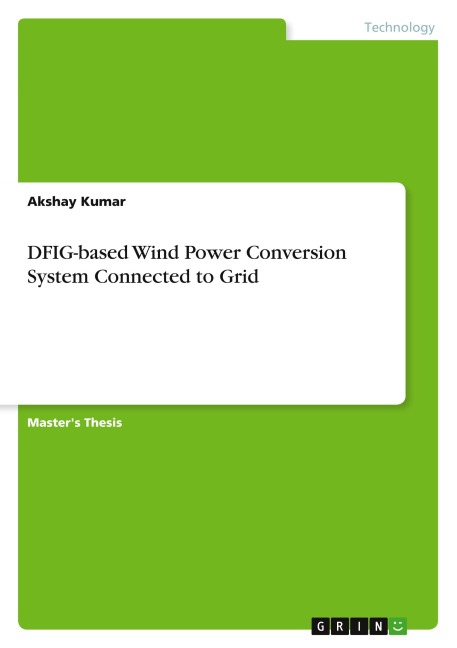
DFIG-based Wind Power Conversion System Connected to Grid - Akshay Kumar
-25% koodilla BOOKS
Toimitus 12-18 arkipäivässä
30 päivän palautusoikeus
Master's Thesis from the year 2014 in the subject Engineering - Power Engineering, grade: 7.8, Ajay Kumar Garg Engineering College, course: M.Tech, language: English, abstract: Wind generation has become the most important alternate energy source and has experienced increased progress in India during the past decade. While it has great potential as an alternative to less environmentally friendly energy sour ... Täydellinen kuvaus
Saatat myös pitää
 TOP
TOP

Determined: The Science of Life Without Free Will
-25% koodilla BOOKS
Toimittajalla varastossa
 TOP
TOP

The Rise and Fall of the Dinosaurs: A New History of a Lost World
-25% koodilla BOOKS
Toimittajalla varastossa
TOP

Factfulness: Ten Reasons We're Wrong About the World--and Why Things Are Better Than You Think
Ola Rosling, Anna Rosling Rönnlund, Hans Rosling
-25% koodilla BOOKS
Toimittajalla varastossa
TOP

Biology: A Global Approach, Global Edition
Neil Campbell, Rebecca Orr, Lisa Urry, Peter Minorsky, Michael Cain, Jane Reece, Steven Wasserman
-25% koodilla BOOKS
Toimittajalla varastossa
TOP

Six Not-so-easy Pieces: Einstein's Relativity, Symmetry, and Space-Time
Richard P. Feynman, Robert B. Leighton, Matthew Sands
-25% koodilla BOOKS
Toimittajalla varastossa
TOP

Entangled Life: How Fungi Make Our Worlds, Change Our Minds and Shape Our Futures
-25% koodilla BOOKS
Toimittajalla varastossa
TOP

The Light Eaters: How the Unseen World of Plant Intelligence Offers a New Understanding of Life on Earth
-25% koodilla BOOKS
Toimittajalla varastossa
TOP


The Age of Alchemy: How Early Innovators Shaped Modern Chemistry
-25% koodilla BOOKS
Toimittajalla varastossa
TOP

The Secrets of our DNA: How Genetics has Changed the World
-25% koodilla BOOKS
Toimittajalla varastossa
TOP

Janeway's Immunobiology
Leslie J. Berg, Kenneth Murphy, Casey Weaver
-25% koodilla BOOKS
Toimittajalla varastossa
TOP

Behave: The Biology of Humans at Our Best and Worst
-25% koodilla BOOKS
Toimittajalla varastossa
TOP

Why We Sleep: Unlocking the Power of Sleep and Dreams
-25% koodilla BOOKS
Varastossa
TOP
Why Machines Learn: The Elegant Maths Behind Modern AI
-25% koodilla BOOKS
Toimittajalla varastossa
TOP

Life As No One Knows It: The Physics of Life's Emergence
-25% koodilla BOOKS
Toimittajalla varastossa
TOP

The Rise and Reign of the Mammals: A New History, from the Shadow of the Dinosaurs to Us
-25% koodilla BOOKS
Toimittajalla varastossa
TOP

Learn Faster, Perform Better: A Musician's Guide to the Neuroscience of Practicing
-25% koodilla BOOKS
Toimittajalla varastossa
TOP
The Brain That Changes Itself: Stories of Personal Triumph from the Frontiers of Brain Science
-25% koodilla BOOKS
Toimittajalla varastossa
 TOP
TOP

How to Solve it: A New Aspect of Mathematical Method
-25% koodilla BOOKS
Toimittajalla varastossa
Kuvaus
Master's Thesis from the year 2014 in the subject Engineering - Power Engineering, grade: 7.8, Ajay Kumar Garg Engineering College, course: M.Tech, language: English, abstract: Wind generation has become the most important alternate energy source and has experienced increased progress in India during the past decade. While it has great potential as an alternative to less environmentally friendly energy sources, there are various technical challenges that cause wind to be considered negatively by many utilities. Wind energy conversion systems suffer from the fact that their real power generation is closely dependent on the local environmental conditions. The Doubly Fed Induction Generator (DFIG) based wind turbine with variable-speed variable-pitch control scheme is the most popular wind power generator in the wind power industry. This machine can be operated either in grid connected or standalone mode. In this thesis, a detailed electromechanical model of a DFIG-based wind turbine connected to power grid as well as separately operated wind turbine system with different sub-systems is developed in the MATLAB/SIMULINK environment and its equivalent generator and turbine control structure is realized. In this regard following configurations have been considered: ¿ DFIG with Battery storage sub-system ¿ DFIG with Buck-Boost converter ¿ DFIG with transformer ¿ DFIG with 3-winding transformer Addition of battery storage and buck-boost converter sub-systems into the system enables not only dispatching of generator power but also decreases the variability in their reactive power requirements. The full control over both active and reactive power is possible by the use of transformer between DFIG and rotor side converter. The steady state behavior of the overall wind turbine system is presented and the steady state reactive power ability of the DFIG is analyzed. It has been shown that major part of the reactive power should be supplied from rotor side converter to reduce the overall rating of the generator. The DFIG with above mentioned sub-systems is connected to grid. The total harmonic distortion analysis and efficiency are carried out. It is found that DFIG with transformer in between machine and rotor side converter has lowest THD (2.29%) and DFIG with 3-winding transformer has maximum efficiency (above 93%).
Lisätietoja
| Kirjoittaja | Akshay Kumar |
|---|---|
| Julkaisija | GRIN Verlag |
| Julkaisuvuosi | 2014 |
| Kannen tyyppi | Pehmeäkantinen |
| EAN | 9783656720294 |