
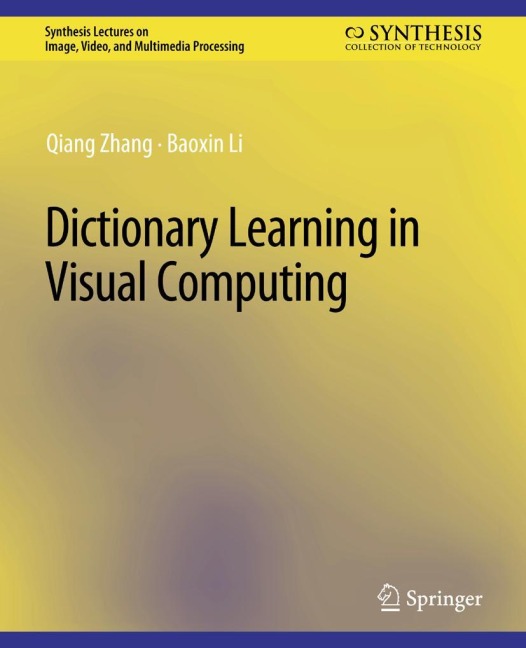
Dictionary Learning in Visual Computing - Baoxin Li,Qiang Zhang
-25% koodilla BOOKS
Toimitus 12-18 arkipäivässä
30 päivän palautusoikeus
The last few years have witnessed fast development on dictionary learning approaches for a set of visual computing tasks, largely due to their utilization in developing new techniques based on sparse representation. Compared with conventional techniques employing manually defined dictionaries, such as Fourier Transform and Wavelet Transform, dictionary learning aims at obtaining a dictionary adaptively from ... Täydellinen kuvaus
Saatat myös pitää


 TOP
TOP

If Anyone Builds It, Everyone Dies: The Case Against Superintelligent AI
Eliezer Yudkowsky, Nate Soares
-25% koodilla BOOKS
Toimittajalla varastossa
TOP


We Are Not Machines: The Fight for the Future of Work
-25% koodilla BOOKS
Toimittajalla varastossa
TOP

Open Circuits: The Inner Beauty of Electronic Components
Eric Schlaepfer, Windell Oskay
-25% koodilla BOOKS
Toimittajalla varastossa
TOP

Get started with MicroPython on Raspberry Pi Pico: The Official Raspberry Pi Pico Guide
-25% koodilla BOOKS
Toimittajalla varastossa
TOP

Practical Electronics for Inventors
-25% koodilla BOOKS
Toimittajalla varastossa
TOP

Fundamentals of Aerodynamics ISE
Christopher Cadou, John D. Anderson
-25% koodilla BOOKS
Toimittajalla varastossa
TOP

Nucleo Boards Programming with the STM32CubeIDE: Hands-on in more than 50 projects
-25% koodilla BOOKS
Toimittajalla varastossa
TOP

Black Holes: The Key to Understanding the Universe
-25% koodilla BOOKS
Toimittajalla varastossa
TOP

Professional SMD Assembly: Practical Low-Cost Methods for Reliable PCB Production
-25% koodilla BOOKS
Toimittajalla varastossa
TOP

KiCad Like A Pro - Fundamentals and Projects: Getting started with the world's best open-source PCB tool
-25% koodilla BOOKS
Toimittajalla varastossa
TOP

Make: Electronics: Learning by Discovery: A hands-on primer for the new electronics enthusiast
-25% koodilla BOOKS
Toimittajalla varastossa
TOP

Data-Driven Science and Engineering: Machine Learning, Dynamical Systems, and Control
Steven L. Brunton, J. Nathan Kutz
-25% koodilla BOOKS
Toimittajalla varastossa
TOP

Flowers For Algernon: A Modern Literary Classic
-25% koodilla BOOKS
Toimittajalla varastossa
TOP

Foundations of Flavor: The Noma Guide to Fermentation: Including Step-By-Step Information on Making and Cooking with: Koji, Kombuchas, Shoyus, Misos, Vinegars, Garums, Lacto-Ferments and black Fruits Vegetables
-25% koodilla BOOKS
Toimittajalla varastossa
TOP

Digital Design and Computer Architecture, RISC-V Edition
-25% koodilla BOOKS
Toimittajalla varastossa
TOP

Blood in the Machine: The Origins of the Rebellion Against Big Tech
-25% koodilla BOOKS
Toimittajalla varastossa
TOP

Mastering the Arduino Uno R4: Programming and Projects for the Minima and WiFi
-25% koodilla BOOKS
Toimittajalla varastossa
TOP

Detailed Mechanical Design: A Practical Guide
-25% koodilla BOOKS
Toimittajalla varastossa
Kuvaus
The last few years have witnessed fast development on dictionary learning approaches for a set of visual computing tasks, largely due to their utilization in developing new techniques based on sparse representation. Compared with conventional techniques employing manually defined dictionaries, such as Fourier Transform and Wavelet Transform, dictionary learning aims at obtaining a dictionary adaptively from the data so as to support optimal sparse representation of the data. In contrast to conventional clustering algorithms like K-means, where a data point is associated with only one cluster center, in a dictionary-based representation, a data point can be associated with a small set of dictionary atoms. Thus, dictionary learning provides a more flexible representation of data and may have the potential to capture more relevant features from the original feature space of the data. One of the early algorithms for dictionary learning is K-SVD. In recent years, many variations/extensionsof K-SVD and other new algorithms have been proposed, with some aiming at adding discriminative capability to the dictionary, and some attempting to model the relationship of multiple dictionaries. One prominent application of dictionary learning is in the general field of visual computing, where long-standing challenges have seen promising new solutions based on sparse representation with learned dictionaries. With a timely review of recent advances of dictionary learning in visual computing, covering the most recent literature with an emphasis on papers after 2008, this book provides a systematic presentation of the general methodologies, specific algorithms, and examples of applications for those who wish to have a quick start on this subject.
Lisätietoja
| Kirjoittaja | Baoxin Li, Qiang Zhang |
|---|---|
| Julkaisija | Springer Nature Switzerland |
| Series | Synthesis Lectures on Image, Video, and Multimedia Processing |
| Julkaisuvuosi | 2015 |
| Kannen tyyppi | Pehmeäkantinen |
| EAN | 9783031011252 |