
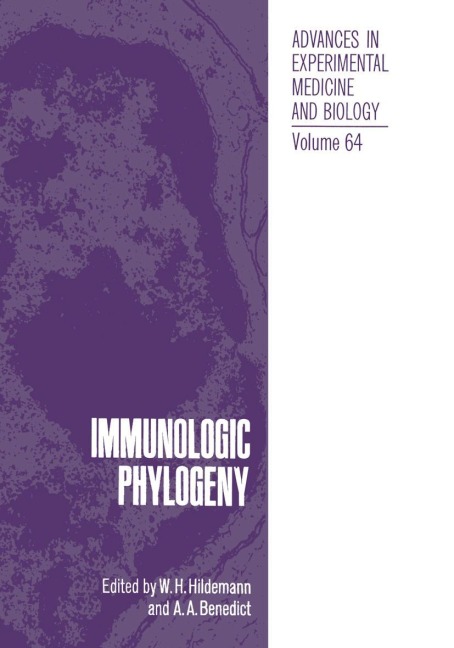
Immunologic Phylogeny -
-25% koodilla BOOKS
Toimitus 12-18 arkipäivässä
30 päivän palautusoikeus
There are two now classic reasons for the widespread and con tinuing interest in the phylogeny of immune reactivities and structure. First is the fundamental concern of biologists with the evolution of defense mechanisms. We are eager to discover origins, mechanisms, and adaptive specializations of immunocompetence because the very existence of individuals and entire species is involved in a most essential ... Täydellinen kuvaus
Saatat myös pitää
 TOP
TOP

The Myth of Normal: Trauma, Illness, and Healing in a Toxic Culture
-25% koodilla BOOKS
Toimittajalla varastossa
TOP
No Bad Parts: Healing Trauma and Restoring Wholeness with the Internal Family Systems Model
-25% koodilla BOOKS
Toimittajalla varastossa
TOP
The Body Keeps the Score: Brain, Mind, and Body in the Healing of Trauma
-25% koodilla BOOKS
Toimittajalla varastossa
TOP

On Connection: 'Powerful' MATT HAIG
-25% koodilla BOOKS
Toimittajalla varastossa
TOP
Oxford Handbook of Clinical Medicine
Peter Hateley, Iain McGurgan, Ian B. Wilkinson, Tim Raine, Dearbhla Kelly, Kate Wiles
-25% koodilla BOOKS
Toimittajalla varastossa
TOP
Harrison's Principles of Internal Medicine (Vol.1 & Vol.2)
Stephen Hauser, Joseph Loscalzo, Steven Holland, Dan Longo, J. Larry Jameson, Dennis Kasper, Carol Langford, Anthony Fauci
-25% koodilla BOOKS
Toimittajalla varastossa
TOP

The Checklist Manifesto: How to Get Things Right
-25% koodilla BOOKS
Toimittajalla varastossa
TOP
Oxford Handbook of Anaesthesia
-25% koodilla BOOKS
Toimittajalla varastossa
TOP

Maybe You Should Talk to Someone: a therapist, her thearapist, and our lives revealed
-25% koodilla BOOKS
Toimittajalla varastossa
 TOP
TOP

How Not To Die: Discover the foods scientifically proven to prevent and reverse disease
-25% koodilla BOOKS
Toimittajalla varastossa
TOP
Lifespan: Why We Age - and Why We Don't Have To
-25% koodilla BOOKS
Toimittajalla varastossa
TOP
Vademecum Metabolicum: Diagnosis and Treatment of Inborn Errors of Metabolism Forword by William L. Nyhan, San Diego, USA
Johannes Zschocke, Georg F. Hoffmann
-25% koodilla BOOKS
Toimittajalla varastossa
TOP

Cellular and Molecular Immunology
Sarah Henrickson, Abul K. Abbas, Andrew H. Lichtman, Shiv Pillai
-25% koodilla BOOKS
Toimittajalla varastossa
TOP

Physics, Pharmacology and Physiology for Anaesthetists: Key Concepts for the FRCA
Matthew E. Cross, Emma V. E. Plunkett
-25% koodilla BOOKS
Toimittajalla varastossa
TOP
Pocket Guide to Teaching for Clinical Instructors
-25% koodilla BOOKS
Toimittajalla varastossa
TOP

Oxford Handbook of Critical Care
Andrew Webb, Mervyn Singer, Alice Carter
-25% koodilla BOOKS
Toimittajalla varastossa
TOP

The Wills Eye Manual: Print + eBook with Multimedia: Office and Emergency Room Diagnosis and Treatment of Eye Disease
-25% koodilla BOOKS
Toimittajalla varastossa
TOP


Who Deserves Your Love: How to Create Boundaries to Start, Strengthen or End Any Relationship
-25% koodilla BOOKS
Toimittajalla varastossa
TOP
Vaccinated - dead: Histopathological findings following COVID-19 vaccination
-25% koodilla BOOKS
Toimittajalla varastossa
Kuvaus
There are two now classic reasons for the widespread and con tinuing interest in the phylogeny of immune reactivities and structure. First is the fundamental concern of biologists with the evolution of defense mechanisms. We are eager to discover origins, mechanisms, and adaptive specializations of immunocompetence because the very existence of individuals and entire species is involved in a most essential way. Second is the strong biomedical interest in adaptive immune mechanisms to increase understanding of health and disease in man. If man and placental mammals represent the quin tessence of immunoresponsiveness with complex interdependent path ways, the less elaborate but fully functional systems of immunity in "lower" animals proffer insights applicable to immediate con cerns in medicine. Recent approaches to organ transplantation, immunotherapy of cancer and repair of immunodeficiency diseases, to name just a few areas, have depended greatly on phylogenetic per spectives. In a larger sense, intelligent wildlife conservation, utilization of food resources, and adequate environmental protection all hinge on knowing how diverse species survive or otherwise suc cumb to insults, injuries, and disease. The phylogenetic immunologist also seeks detailed information on the structure of the immunoglobulins which relates directly to the evolutionary history of living animals. Perhaps genetic mech anisms responsible for the evolution of these proteins may be re vealed as spin-off information. The vast number of immunoglobulin specificities and effector structures, coupled with the remarkable phylogenetic conservation of certain polypeptide regions, makes these molecules especially useful to protein chemists as well as immunologists.
Lisätietoja
| Julkaisija | Springer New York |
|---|---|
| Series | Advances in Experimental Medicine and Biology |
| Julkaisuvuosi | 2013 |
| Kannen tyyppi | Pehmeäkantinen |
| EAN | 9781468432633 |