
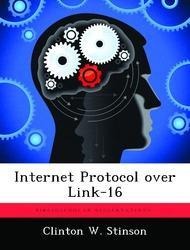
Internet Protocol over Link-16 - Clinton W. Stinson
-35% koodilla BOOKS
30 päivän palautusoikeus
The purpose of Link-16 is to exchange real-time tactical data among units of the United States and allied forces. Primary Link-16 functions include exchange of friendly unit position and status data, the dissemination of tactical surveillance track data, and the control/management of air, surface, and subsurface engagements. Because Link-16 will play an integral part in the network-centric Joint Battlespace ... Täydellinen kuvaus
Saatat myös pitää
 TOP
TOP

The Culture Map: Breaking Through the Invisible Boundaries of Global Business
-35% koodilla BOOKS
Varastossa
TOP

Atomic Habits: An Easy & Proven Way to Build Good Habits & Break Bad Ones
-35% koodilla BOOKS
Varastossa
TOP


The Nord Stream Conspiracy: The Inside Story of the Explosions That Shook the World
-35% koodilla BOOKS
Toimittajalla varastossa
TOP

Women Who Run with the Wolves: Myths and Stories of the Wild Woman Archetype
Clarissa Pinkola Estés, Clarissa Pinkola Estes
-35% koodilla BOOKS
Toimittajalla varastossa
TOP

Sapiens: A Brief History of Humankind
-35% koodilla BOOKS
Toimittajalla varastossa
TOP
How Democracies Die
Steven Levitsky, Daniel Ziblatt
-35% koodilla BOOKS
Toimittajalla varastossa
 TOP
TOP

Prisoners of Geography: Updated 10th Anniversary Edition: Ten Maps That Tell You Everything You Need To Know About Global Politics
-35% koodilla BOOKS
Toimittajalla varastossa
TOP

Classic Football Shirts
Classic Football Shirts, Rory Smith
-35% koodilla BOOKS
Toimittajalla varastossa
 TOP
TOP

The Whole-Brain Child: 12 Revolutionary Strategies to Nurture Your Child's Developing Mind
Daniel J. Siegel, Tina Payne Bryson
-35% koodilla BOOKS
Toimittajalla varastossa

 TOP
TOP

Everything I Know About Love: Now a Major BBC One Series
-35% koodilla BOOKS
Varastossa
TOP

Braiding Sweetgrass: Indigenous Wisdom, Scientific Knowledge and the Teachings of Plants
-35% koodilla BOOKS
Toimittajalla varastossa
TOP

The Unabridged Journals of Sylvia Plath
-35% koodilla BOOKS
Toimittajalla varastossa
TOP

To Kill a Mockingbird. 60th Anniversary Edition
-35% koodilla BOOKS
Toimittajalla varastossa
 TOP
TOP

Caliban and the Witch: Women, the Body and Primitive Accumulation
-35% koodilla BOOKS
Toimittajalla varastossa
TOP

Breaking Through: My Life in Science
-35% koodilla BOOKS
Toimittajalla varastossa
Kuvaus
The purpose of Link-16 is to exchange real-time tactical data among units of the United States and allied forces. Primary Link-16 functions include exchange of friendly unit position and status data, the dissemination of tactical surveillance track data, and the control/management of air, surface, and subsurface engagements. Because Link-16 will play an integral part in the network-centric Joint Battlespace Infosphere (JBI), the performance of Internet Protocol version six (IPv6) and IP Security (IPSec) over Link-16 needs to be determined. IP packets also afford additional security measures within the JBI. Using OPNET modeling software to simulate a Link-16 network, the investigation of this research revealed that the overhead from IPv6 and IPSec does not significantly affect end-to-end delay and effective throughput of the Link-16 network. As long as the encryption and authentication protocols are preprocessed, these protocols add minimal amounts of latency overhead to the Link-16 network. However, as the offered load is extended beyond the 90 % level, the overhead from the IPSec extensions begins to have more of a negative effect on the End-to-End delay and throughput.
Lisätietoja
| Kirjoittaja | Clinton W. Stinson |
|---|---|
| Julkaisija | Creative Media Partners, LLC |
| Julkaisuvuosi | 2012 |
| Kannen tyyppi | Pehmeäkantinen |
| EAN | 9781288282715 |