
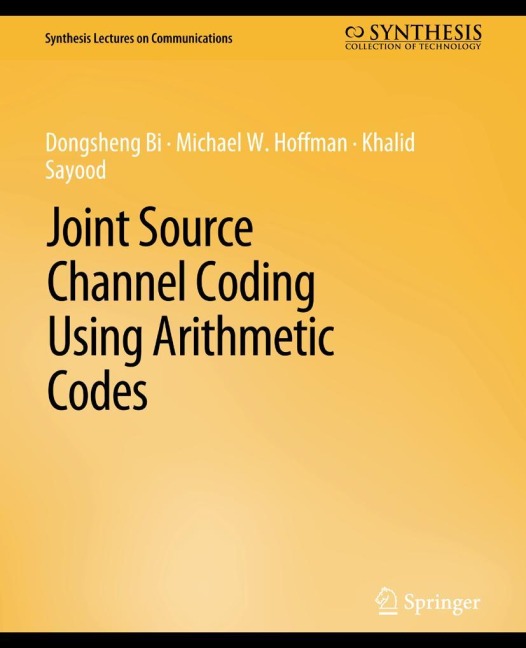
Joint Source Channel Coding Using Arithmetic Codes - Khalid Sayood,Bi Dongsheng,Michael Hoffman
-25% koodilla BOOKS
Toimitus 12-18 arkipäivässä
30 päivän palautusoikeus
Based on the encoding process, arithmetic codes can be viewed as tree codes and current proposals for decoding arithmetic codes with forbidden symbols belong to sequential decoding algorithms and their variants. In this monograph, we propose a new way of looking at arithmetic codes with forbidden symbols. If a limit is imposed on the maximum value of a key parameter in the encoder, this modified arithmetic ... Täydellinen kuvaus
Saatat myös pitää

 TOP
TOP
If Anyone Builds It, Everyone Dies: The Case Against Superintelligent AI
Eliezer Yudkowsky, Nate Soares
-25% koodilla BOOKS
Toimittajalla varastossa
 TOP
TOP
Practical Electronics for Inventors
-25% koodilla BOOKS
Toimittajalla varastossa
TOP
Get started with MicroPython on Raspberry Pi Pico: The Official Raspberry Pi Pico Guide
-25% koodilla BOOKS
Toimittajalla varastossa
TOP

We Are Not Machines: The Fight for the Future of Work
-25% koodilla BOOKS
Toimittajalla varastossa
TOP

Fundamentals of Aerodynamics ISE
Christopher Cadou, John D. Anderson
-25% koodilla BOOKS
Toimittajalla varastossa
TOP
Open Circuits: The Inner Beauty of Electronic Components
Eric Schlaepfer, Windell Oskay
-25% koodilla BOOKS
Toimittajalla varastossa
TOP

Nucleo Boards Programming with the STM32CubeIDE: Hands-on in more than 50 projects
-25% koodilla BOOKS
Toimittajalla varastossa
TOP
Data-Driven Science and Engineering: Machine Learning, Dynamical Systems, and Control
Steven L. Brunton, J. Nathan Kutz
-25% koodilla BOOKS
Toimittajalla varastossa
TOP

Black Holes: The Key to Understanding the Universe
-25% koodilla BOOKS
Toimittajalla varastossa
TOP

Flowers For Algernon: A Modern Literary Classic
-25% koodilla BOOKS
Toimittajalla varastossa
TOP
KiCad Like A Pro - Fundamentals and Projects: Getting started with the world's best open-source PCB tool
-25% koodilla BOOKS
Toimittajalla varastossa
TOP
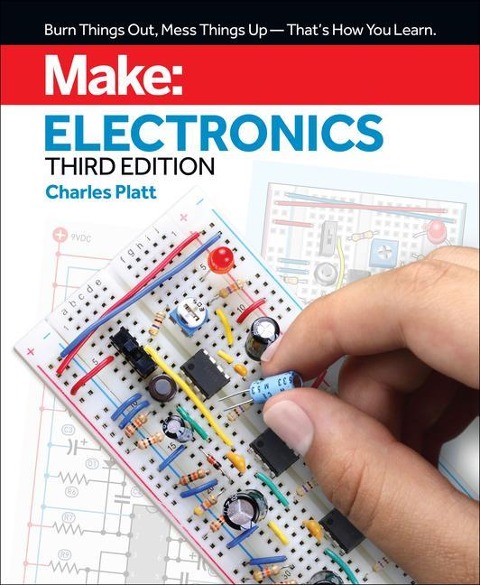
Make: Electronics: Learning by Discovery: A hands-on primer for the new electronics enthusiast
-25% koodilla BOOKS
Toimittajalla varastossa
TOP
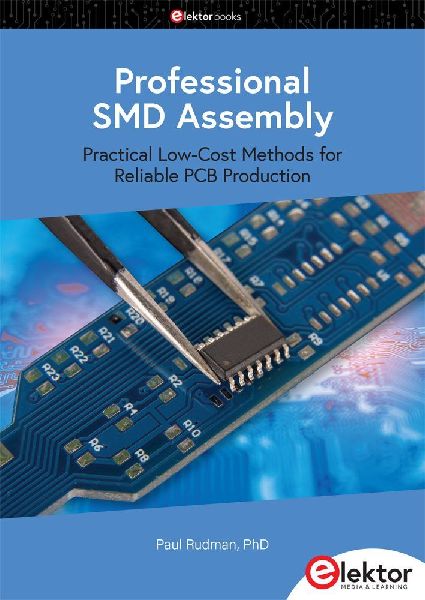
Professional SMD Assembly: Practical Low-Cost Methods for Reliable PCB Production
-25% koodilla BOOKS
Toimittajalla varastossa
TOP

Foundations of Flavor: The Noma Guide to Fermentation: Including Step-By-Step Information on Making and Cooking with: Koji, Kombuchas, Shoyus, Misos, Vinegars, Garums, Lacto-Ferments and black Fruits Vegetables
-25% koodilla BOOKS
Toimittajalla varastossa
TOP

Mastering the Arduino Uno R4: Programming and Projects for the Minima and WiFi
-25% koodilla BOOKS
Toimittajalla varastossa
TOP
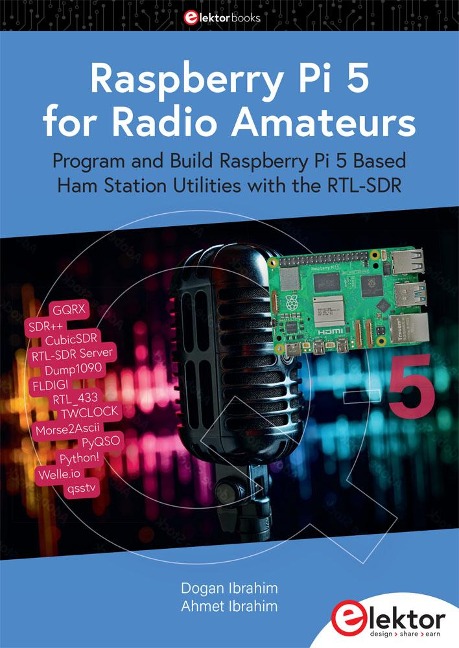
Raspberry Pi 5 for Radio Amateurs: Program and Build Raspberry Pi 5 Based Ham Station Utilities with the RTL-SDR
-25% koodilla BOOKS
Toimittajalla varastossa
TOP

Digital Design and Computer Architecture, RISC-V Edition
-25% koodilla BOOKS
Toimittajalla varastossa
TOP

AI 2041: Ten Visions for Our Future
-25% koodilla BOOKS
Toimittajalla varastossa
Kuvaus
Based on the encoding process, arithmetic codes can be viewed as tree codes and current proposals for decoding arithmetic codes with forbidden symbols belong to sequential decoding algorithms and their variants. In this monograph, we propose a new way of looking at arithmetic codes with forbidden symbols. If a limit is imposed on the maximum value of a key parameter in the encoder, this modified arithmetic encoder can also be modeled as a finite state machine and the code generated can be treated as a variable-length trellis code. The number of states used can be reduced and techniques used for decoding convolutional codes, such as the list Viterbi decoding algorithm, can be applied directly on the trellis. The finite state machine interpretation can be easily migrated to Markov source case. We can encode Markov sources without considering the conditional probabilities, while using the list Viterbi decoding algorithm which utilizes the conditional probabilities. We can also use context-based arithmetic coding to exploit the conditional probabilities of the Markov source and apply a finite state machine interpretation to this problem. The finite state machine interpretation also allows us to more systematically understand arithmetic codes with forbidden symbols. It allows us to find the partial distance spectrum of arithmetic codes with forbidden symbols. We also propose arithmetic codes with memories which use high memory but low implementation precision arithmetic codes. The low implementation precision results in a state machine with less complexity. The introduced input memories allow us to switch the probability functions used for arithmetic coding. Combining these two methods give us a huge parameter space of the arithmetic codes with forbidden symbols. Hence we can choose codes with better distance properties while maintaining the encoding efficiency and decoding complexity. A construction and search method is proposed and simulation results show that we can achieve a similar performance as turbo codes when we apply this approach to rate 2/3 arithmetic codes. Table of Contents: Introduction / Arithmetic Codes / Arithmetic Codes with Forbidden Symbols / Distance Property and Code Construction / Conclusion
Lisätietoja
| Kirjoittaja | Khalid Sayood, Bi Dongsheng, Michael Hoffman |
|---|---|
| Julkaisija | Springer Nature Switzerland |
| Series | Synthesis Lectures on Communications |
| Julkaisuvuosi | 2009 |
| Kannen tyyppi | Pehmeäkantinen |
| EAN | 9783031005473 |