
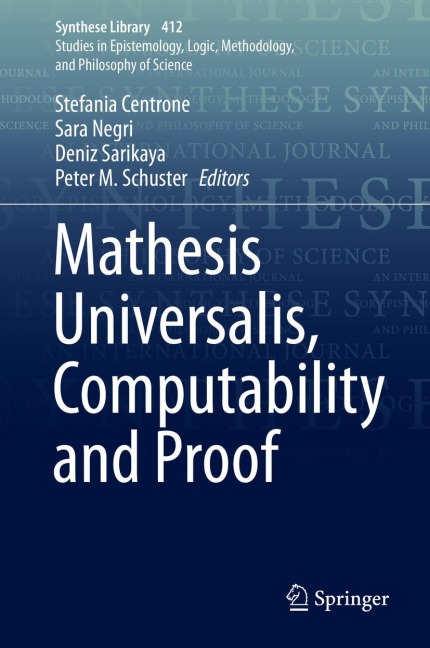
Mathesis Universalis, Computability and Proof -
-25% koodilla BOOKS
Toimitus 17-23 arkipäivässä
30 päivän palautusoikeus
In a fragment entitled Elementa Nova Matheseos Universalis (1683?) Leibniz writes ¿the mathesis [¿] shall deliver the method through which things that are conceivable can be exactly determined¿; in another fragment he takes the mathesis to be ¿the science of all things that are conceivable.¿ Leibniz considers all mathematical disciplines as branches of the mathesis and conceives the mathesis as a general sc ... Täydellinen kuvaus
Saatat myös pitää
 TOP
TOP

Determined: The Science of Life Without Free Will
-25% koodilla BOOKS
Toimittajalla varastossa
 TOP
TOP

The Rise and Fall of the Dinosaurs: A New History of a Lost World
-25% koodilla BOOKS
Toimittajalla varastossa
TOP
Factfulness: Ten Reasons We're Wrong About the World--and Why Things Are Better Than You Think
Ola Rosling, Anna Rosling Rönnlund, Hans Rosling
-25% koodilla BOOKS
Toimittajalla varastossa
TOP

Biology: A Global Approach, Global Edition
Neil Campbell, Rebecca Orr, Lisa Urry, Peter Minorsky, Michael Cain, Jane Reece, Steven Wasserman
-25% koodilla BOOKS
Toimittajalla varastossa
TOP

Six Not-so-easy Pieces: Einstein's Relativity, Symmetry, and Space-Time
Richard P. Feynman, Robert B. Leighton, Matthew Sands
-25% koodilla BOOKS
Toimittajalla varastossa
TOP

Entangled Life: How Fungi Make Our Worlds, Change Our Minds and Shape Our Futures
-25% koodilla BOOKS
Toimittajalla varastossa
TOP

The Light Eaters: How the Unseen World of Plant Intelligence Offers a New Understanding of Life on Earth
-25% koodilla BOOKS
Toimittajalla varastossa
TOP


The Age of Alchemy: How Early Innovators Shaped Modern Chemistry
-25% koodilla BOOKS
Toimittajalla varastossa
TOP

The Secrets of our DNA: How Genetics has Changed the World
-25% koodilla BOOKS
Toimittajalla varastossa
TOP

Janeway's Immunobiology
Leslie J. Berg, Kenneth Murphy, Casey Weaver
-25% koodilla BOOKS
Toimittajalla varastossa
TOP
Behave: The Biology of Humans at Our Best and Worst
-25% koodilla BOOKS
Toimittajalla varastossa
TOP
Why We Sleep: Unlocking the Power of Sleep and Dreams
-25% koodilla BOOKS
Varastossa
TOP
Why Machines Learn: The Elegant Maths Behind Modern AI
-25% koodilla BOOKS
Toimittajalla varastossa
TOP

Life As No One Knows It: The Physics of Life's Emergence
-25% koodilla BOOKS
Toimittajalla varastossa
TOP
The Rise and Reign of the Mammals: A New History, from the Shadow of the Dinosaurs to Us
-25% koodilla BOOKS
Toimittajalla varastossa
TOP
Learn Faster, Perform Better: A Musician's Guide to the Neuroscience of Practicing
-25% koodilla BOOKS
Toimittajalla varastossa
TOP
The Brain That Changes Itself: Stories of Personal Triumph from the Frontiers of Brain Science
-25% koodilla BOOKS
Toimittajalla varastossa
 TOP
TOP

How to Solve it: A New Aspect of Mathematical Method
-25% koodilla BOOKS
Toimittajalla varastossa
Kuvaus
In a fragment entitled Elementa Nova Matheseos Universalis (1683?) Leibniz writes ¿the mathesis [¿] shall deliver the method through which things that are conceivable can be exactly determined¿; in another fragment he takes the mathesis to be ¿the science of all things that are conceivable.¿ Leibniz considers all mathematical disciplines as branches of the mathesis and conceives the mathesis as a general science of forms applicable not only to magnitudes but to every object that exists in our imagination, i.e. that is possible at least in principle. As a general science of forms the mathesis investigates possible relations between ¿arbitrary objects¿ (¿objets quelconques¿). It is an abstract theory of combinations and relations among objects whatsoever. In 1810 the mathematician and philosopher Bernard Bolzano published a booklet entitled Contributions to a Better-Grounded Presentation of Mathematics. There is, according to him, a certain objective connection among the truths that are germane to a certain homogeneous field of objects: some truths are the ¿reasons¿ (¿Gründe¿) of others, and the latter are ¿consequences¿ (¿Folgen¿) of the former. The reason-consequence relation seems to be the counterpart of causality at the level of a relation between true propositions. Arigorous proof is characterized in this context as a proof that shows the reason of the proposition that is to be proven. Requirements imposed on rigorous proofs seem to anticipate normalization results in current proof theory. The contributors of Mathesis Universalis, Computability and Proof, leading experts in the fields of computer science, mathematics, logic and philosophy, show the evolution of these and related ideas exploring topics in proof theory, computability theory, intuitionisticlogic, constructivism and reverse mathematics, delving deeply into a contextual examination of the relationship between mathematical rigor and demands for simplification.
Lisätietoja
| Julkaisija | Springer Nature Switzerland |
|---|---|
| Series | Synthese Library |
| Julkaisuvuosi | 2019 |
| Kannen tyyppi | Kovakantinen |
| EAN | 9783030204464 |