
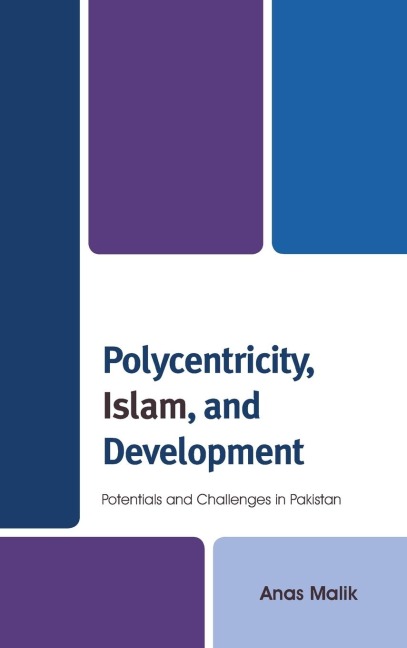
Polycentricity, Islam, and Development: Potentials and Challenges in Pakistan - Anas Malik
-25% koodilla BOOKS
Toimitus 17-23 arkipäivässä
30 päivän palautusoikeus
Development analysts often focus on the role of "the state" in making the right rules by which to govern society, assuming that governance is exclusively or mainly the work of the central government authority. The reality in many developing countries, particularly those with weak central government authorities, is that governance happens through diverse rules and in many centers of decision-making, in ways ... Täydellinen kuvaus
Saatat myös pitää
 TOP
TOP

The Culture Map: Breaking Through the Invisible Boundaries of Global Business
-25% koodilla BOOKS
Varastossa
TOP

Atomic Habits: An Easy & Proven Way to Build Good Habits & Break Bad Ones
-25% koodilla BOOKS
Varastossa
TOP

The Nord Stream Conspiracy: The Inside Story of the Explosions That Shook the World
-25% koodilla BOOKS
Loppu
 TOP
TOP
Prisoners of Geography: Updated 10th Anniversary Edition: Ten Maps That Tell You Everything You Need To Know About Global Politics
-25% koodilla BOOKS
Toimittajalla varastossa
TOP

Women Who Run with the Wolves: Myths and Stories of the Wild Woman Archetype
Clarissa Pinkola Estés, Clarissa Pinkola Estes
-25% koodilla BOOKS
Toimittajalla varastossa
TOP
Sapiens: A Brief History of Humankind
-25% koodilla BOOKS
Toimittajalla varastossa
TOP
How Democracies Die
Steven Levitsky, Daniel Ziblatt
-25% koodilla BOOKS
Toimittajalla varastossa
TOP


Classic Football Shirts
Classic Football Shirts, Rory Smith
-25% koodilla BOOKS
Toimittajalla varastossa
 TOP
TOP

The Whole-Brain Child: 12 Revolutionary Strategies to Nurture Your Child's Developing Mind
Daniel J. Siegel, Tina Payne Bryson
-25% koodilla BOOKS
Toimittajalla varastossa
 TOP
TOP

Everything I Know About Love: Now a Major BBC One Series
-25% koodilla BOOKS
Varastossa
TOP

Braiding Sweetgrass: Indigenous Wisdom, Scientific Knowledge and the Teachings of Plants
-25% koodilla BOOKS
Toimittajalla varastossa
TOP

The Unabridged Journals of Sylvia Plath
-25% koodilla BOOKS
Toimittajalla varastossa
 TOP
TOP

To Kill a Mockingbird. 60th Anniversary Edition
-25% koodilla BOOKS
Toimittajalla varastossa
 TOP
TOP

The Testaments: The Sequel to The Handmaid's Tale
-25% koodilla BOOKS
Toimittajalla varastossa
TOP
Caliban and the Witch: Women, the Body and Primitive Accumulation
-25% koodilla BOOKS
Toimittajalla varastossa
Kuvaus
Development analysts often focus on the role of "the state" in making the right rules by which to govern society, assuming that governance is exclusively or mainly the work of the central government authority. The reality in many developing countries, particularly those with weak central government authorities, is that governance happens through diverse rules and in many centers of decision-making, in ways that are formal and informal, official and unofficial. This real-world polycentricity can be dysfunctional or productive, depending in part on shared understandings between decision-making entities about how to relate to each other. Those shared understandings come from cultural backgrounds, historical interactions, and other sources. Political economist Anas Malik argues that well-functioning polycentricity in developing countries depends in part on the shared understandings between official government entities and unofficial units that provide collective choice in particular arenas. In Muslim-majority contexts, the Islamic tradition - contrary to the image of a top-down, single-voiced religious law- provides ample resources supporting shared understandings that accommodate diverse rules and collective choice units. Pakistan, the largest Muslim-majority country at its founding, provides an important case. After building on the development literature to suggest a typology of collective choice units in developing countries, Malik explores resources in the Islamic tradition that support polycentric governance. The book then examines major deliberations in Pakistan's history, particularly through documented inquiries into serious political crises such as sectarian religious agitation and civil war, and through a selective survey of types of jurisdictions and collective choice units. Malik argues that there are significant polycentric understandings in Pakistan's historical lineage, but that these are heavily contested. While there is potential for polycentric development in Pakistan, the viability of polycentric order is constrained by countering forces and contextual factors.
Lisätietoja
| Kirjoittaja | Anas Malik |
|---|---|
| Julkaisija | Lexington Books |
| Julkaisuvuosi | 2017 |
| Kannen tyyppi | Kovakantinen |
| EAN | 9781498539753 |