
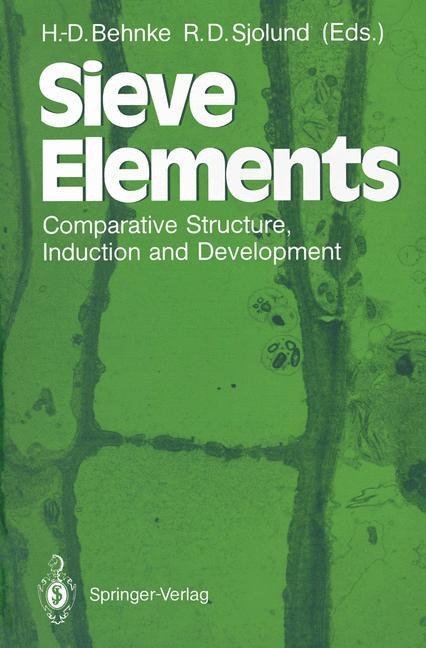
Sieve Elements: Comparative Structure, Induction and Development -
-25% koodilla BOOKS
Toimitus 12-18 arkipäivässä
30 päivän palautusoikeus
As part of his Comparative Investigations of the Organization of the Trunk of the Native Forest Trees (Theodor Hartig 1837, Vergleichende Untersuchungen tiber die Organisation des Stammes der einheimischen Waldbaume. lahresberichte tiber die Fortschritte der Forstwissenschaften und forstlichen Naturkunde 1: 125-168) Hartig gives an anatomical description of the "composition and nature" of the then "complete ... Täydellinen kuvaus
Saatat myös pitää
 TOP
TOP
Biology: A Global Approach, Global Edition
Neil Campbell, Rebecca Orr, Lisa Urry, Peter Minorsky, Michael Cain, Jane Reece, Steven Wasserman
-25% koodilla BOOKS
Toimittajalla varastossa
TOP

Six Not-so-easy Pieces: Einstein's Relativity, Symmetry, and Space-Time
Richard P. Feynman, Robert B. Leighton, Matthew Sands
-25% koodilla BOOKS
Toimittajalla varastossa
TOP

Determined: The Science of Life Without Free Will
-25% koodilla BOOKS
Toimittajalla varastossa
 TOP
TOP


The Age of Alchemy: How Early Innovators Shaped Modern Chemistry
-25% koodilla BOOKS
Toimittajalla varastossa
TOP

The Secrets of our DNA: How Genetics has Changed the World
-25% koodilla BOOKS
Toimittajalla varastossa
TOP

Janeway's Immunobiology
Leslie J. Berg, Kenneth Murphy, Casey Weaver
-25% koodilla BOOKS
Toimittajalla varastossa
TOP

How to Solve it: A New Aspect of Mathematical Method
-25% koodilla BOOKS
Toimittajalla varastossa
TOP

Why We Sleep: Unlocking the Power of Sleep and Dreams
-25% koodilla BOOKS
Varastossa
TOP

The Light Eaters: How the Unseen World of Plant Intelligence Offers a New Understanding of Life on Earth
-25% koodilla BOOKS
Toimittajalla varastossa
TOP

Six Easy Pieces: Essentials of Physics Explained by Its Most Brilliant Teacher
Richard P. Feynman, Robert B. Leighton, Matthew Sands
-25% koodilla BOOKS
Toimittajalla varastossa
TOP

The Rise and Fall of the Dinosaurs: A New History of a Lost World
-25% koodilla BOOKS
Toimittajalla varastossa
TOP
The Rise and Reign of the Mammals: A New History, from the Shadow of the Dinosaurs to Us
-25% koodilla BOOKS
Toimittajalla varastossa
TOP

Learn Faster, Perform Better: A Musician's Guide to the Neuroscience of Practicing
-25% koodilla BOOKS
Toimittajalla varastossa
TOP

Why Machines Learn: The Elegant Maths Behind Modern AI
-25% koodilla BOOKS
Toimittajalla varastossa
TOP

Beyond Inheritance: Our Ever-Mutating Cells and a New Understanding of Health
-25% koodilla BOOKS
Toimittajalla varastossa
 TOP
TOP

The Feynman Lectures on Physics. The New Millennium Edition
Matthew Sands, Robert Leighton, Richard Feynman
-25% koodilla BOOKS
Toimittajalla varastossa
TOP

Thing Explainer: Complicated Stuff in Simple Words
-25% koodilla BOOKS
Toimittajalla varastossa
TOP

Behave: The Biology of Humans at Our Best and Worst
-25% koodilla BOOKS
Toimittajalla varastossa
Kuvaus
As part of his Comparative Investigations of the Organization of the Trunk of the Native Forest Trees (Theodor Hartig 1837, Vergleichende Untersuchungen tiber die Organisation des Stammes der einheimischen Waldbaume. lahresberichte tiber die Fortschritte der Forstwissenschaften und forstlichen Naturkunde 1: 125-168) Hartig gives an anatomical description of the "composition and nature" of the then "completely uninvestigated elementary organs" of what he called the "sap skin" (Safthaut) of trees, a tissue for which Nageli later (1858) coined the term phloem. Within the "Safthaut" Hartig describes three cell types in detail, (1) "Siebfasern", (2) "Siebrohren", and (3) "keulenfOrmige Saftrohren" (club-shaped sap-tubes). While the description of the latter refers to laticifers in Euphorbia and resin ducts in Acer and Robinia. "Siebfasern" and "Siebrohren" comprise the sieve elements. A literal translation of the more significant parts of the description of these cell types demonstrates that his "Siebrohren" entirely correspond to what has later been defined as "sieve tubes" but that his "Siebfasern" are less well defined and in addition to what we call "sieve cells" also include small sieve tubes as well as spindle-shaped cells of cambium, phloem parenchyma and sclerenchyma. Both in his "Siebfasern" and "Siebrohren" Hartig describes sieve areas (his expression is "lense-shaped cavities") and sieve pores (Siebporen).
Lisätietoja
| Julkaisija | Springer Berlin Heidelberg |
|---|---|
| Julkaisuvuosi | 2011 |
| Kannen tyyppi | Pehmeäkantinen |
| EAN | 9783642744471 |