
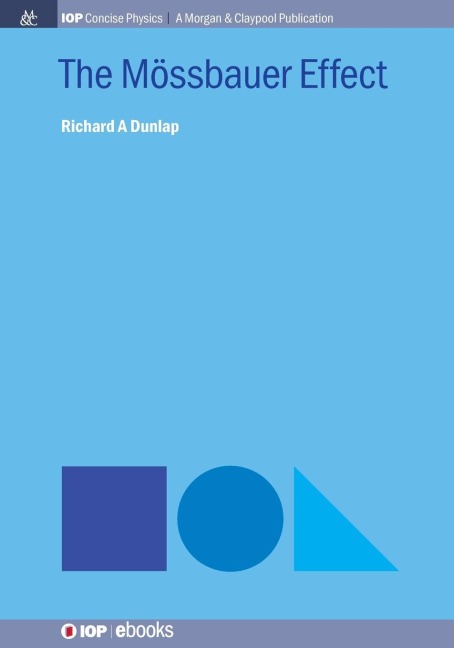
The Mössbauer Effect - Richard A. Dunlap
-35% koodilla BOOKS
Toimitus 15-21 arkipäivässä
30 päivän palautusoikeus
The effect which now bears his name, was discovered in 1958 by Rudolf Mössbauer at the Technical University of Munich. At first, this appeared to be a phenomenon related to nuclear energy levels that provided some information about excited state lifetimes and quantum properties. However, it soon became apparent that Mössbauer spectroscopy had applications in such diverse fields as general relativity, solid ... Täydellinen kuvaus
Saatat myös pitää
 TOP
TOP

Determined: The Science of Life Without Free Will
-35% koodilla BOOKS
Toimittajalla varastossa
TOP

The Light Eaters: How the Unseen World of Plant Intelligence Offers a New Understanding of Life on Earth
-35% koodilla BOOKS
Toimittajalla varastossa
 TOP
TOP

Why We Sleep: Unlocking the Power of Sleep and Dreams
-35% koodilla BOOKS
Varastossa
TOP

The Rise and Fall of the Dinosaurs: A New History of a Lost World
-35% koodilla BOOKS
Toimittajalla varastossa
TOP

Biology: A Global Approach, Global Edition
Neil Campbell, Rebecca Orr, Lisa Urry, Peter Minorsky, Michael Cain, Jane Reece, Steven Wasserman
-35% koodilla BOOKS
Toimittajalla varastossa
TOP

Six Not-so-easy Pieces: Einstein's Relativity, Symmetry, and Space-Time
Richard P. Feynman, Robert B. Leighton, Matthew Sands
-35% koodilla BOOKS
Toimittajalla varastossa
TOP


The Age of Alchemy: How Early Innovators Shaped Modern Chemistry
-35% koodilla BOOKS
Toimittajalla varastossa
TOP

Factfulness: Ten Reasons We're Wrong About the World--and Why Things Are Better Than You Think
Ola Rosling, Anna Rosling Rönnlund, Hans Rosling
-35% koodilla BOOKS
Toimittajalla varastossa
TOP
Why Machines Learn: The Elegant Maths Behind Modern AI
-35% koodilla BOOKS
Toimittajalla varastossa
TOP
Seven Brief Lessons on Physics
-35% koodilla BOOKS
Toimittajalla varastossa
TOP

Entangled Life: How Fungi Make Our Worlds, Change Our Minds and Shape Our Futures
-35% koodilla BOOKS
Toimittajalla varastossa
TOP

Life As No One Knows It: The Physics of Life's Emergence
-35% koodilla BOOKS
Toimittajalla varastossa
TOP

The Rise and Reign of the Mammals: A New History, from the Shadow of the Dinosaurs to Us
-35% koodilla BOOKS
Toimittajalla varastossa
TOP

Molecular Biology of the Cell
David Morgan, Alexander Johnson, Rebecca Heald, Bruce Alberts, Martin Raff
-35% koodilla BOOKS
Toimittajalla varastossa
TOP

Learn Faster, Perform Better: A Musician's Guide to the Neuroscience of Practicing
-35% koodilla BOOKS
Toimittajalla varastossa
TOP

Janeway's Immunobiology
Leslie J. Berg, Kenneth Murphy, Casey Weaver
-35% koodilla BOOKS
Toimittajalla varastossa
TOP

The Road to Reality: A Complete Guide to the Laws of the Universe
-35% koodilla BOOKS
Toimittajalla varastossa
TOP
The Brain That Changes Itself: Stories of Personal Triumph from the Frontiers of Brain Science
-35% koodilla BOOKS
Toimittajalla varastossa
TOP

How to Solve it: A New Aspect of Mathematical Method
-35% koodilla BOOKS
Toimittajalla varastossa
Kuvaus
The effect which now bears his name, was discovered in 1958 by Rudolf Mössbauer at the Technical University of Munich. At first, this appeared to be a phenomenon related to nuclear energy levels that provided some information about excited state lifetimes and quantum properties. However, it soon became apparent that Mössbauer spectroscopy had applications in such diverse fields as general relativity, solid state physics, chemistry, materials science, biology, medical physics, archeology and art. It is the extreme sensitivity of the effect to the atomic environment around the probe atom as well as the ability to apply the technique to some interesting and important elements, most notably iron, that is responsible for the Mössbauer effect's extensive use. The present volume reviews the historical development of the Mössbauer effect, the experimental details, the basic physics of hyperfine interactions and some of the numerous applications of Mössbauer effect spectroscopy.
Lisätietoja
| Kirjoittaja | Richard A. Dunlap |
|---|---|
| Julkaisija | IOP Concise Physics |
| Julkaisuvuosi | 2019 |
| Kannen tyyppi | Pehmeäkantinen |
| EAN | 9781643274799 |