
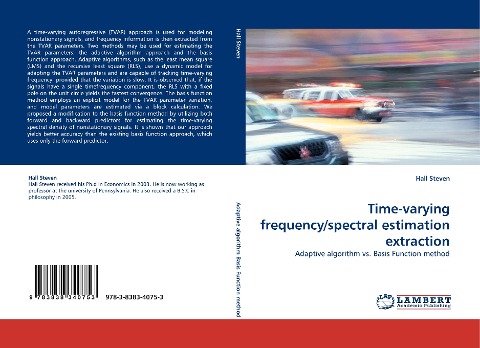
Time-varying frequency/spectral estimation extraction: Adaptive algorithm vs. Basis Function method - Hall Steven
-25% koodilla BOOKS
Toimitus 12-18 arkipäivässä
30 päivän palautusoikeus
A time-varying autoregressive (TVAR) approach is used for modeling nonstationary signals, and frequency information is then extracted from the TVAR parameters. Two methods may be used for estimating the TVAR parameters: the adaptive algorithm approach and the basis function approach. Adaptive algorithms, such as the least mean square (LMS) and the recursive least square (RLS), use a dynamic model for adapti ... Täydellinen kuvaus
Saatat myös pitää
 TOP
TOP

Six Not-so-easy Pieces: Einstein's Relativity, Symmetry, and Space-Time
Richard P. Feynman, Robert B. Leighton, Matthew Sands
-25% koodilla BOOKS
Toimittajalla varastossa
TOP

Six Easy Pieces: Essentials of Physics Explained by Its Most Brilliant Teacher
Richard P. Feynman, Robert B. Leighton, Matthew Sands
-25% koodilla BOOKS
Toimittajalla varastossa
TOP

Behave: The Biology of Humans at Our Best and Worst
-25% koodilla BOOKS
Toimittajalla varastossa
TOP


The Age of Alchemy: How Early Innovators Shaped Modern Chemistry
-25% koodilla BOOKS
Toimittajalla varastossa
TOP

The Secrets of our DNA: How Genetics has Changed the World
-25% koodilla BOOKS
Toimittajalla varastossa
TOP

Why We Sleep: Unlocking the Power of Sleep and Dreams
-25% koodilla BOOKS
Varastossa
TOP

Astrophysics for People in a Hurry: Essays on the Universe and Our Place Within It
-25% koodilla BOOKS
Toimittajalla varastossa
TOP

The Rise and Fall of the Dinosaurs: A New History of a Lost World
-25% koodilla BOOKS
Toimittajalla varastossa
TOP

The Rise and Reign of the Mammals: A New History, from the Shadow of the Dinosaurs to Us
-25% koodilla BOOKS
Toimittajalla varastossa
TOP

Determined: The Science of Life Without Free Will
-25% koodilla BOOKS
Toimittajalla varastossa
TOP

Learn Faster, Perform Better: A Musician's Guide to the Neuroscience of Practicing
-25% koodilla BOOKS
Toimittajalla varastossa
TOP

Beyond Inheritance: Our Ever-Mutating Cells and a New Understanding of Health
-25% koodilla BOOKS
Toimittajalla varastossa
 TOP
TOP

How to Solve it: A New Aspect of Mathematical Method
-25% koodilla BOOKS
Toimittajalla varastossa
TOP

Thing Explainer: Complicated Stuff in Simple Words
-25% koodilla BOOKS
Toimittajalla varastossa
TOP
Introduction to Quantum Mechanics
Darrell F. Schroeter, David J. Griffiths
-25% koodilla BOOKS
Toimittajalla varastossa
TOP

Factfulness: Ten Reasons We're Wrong About the World--and Why Things Are Better Than You Think
Ola Rosling, Anna Rosling Rönnlund, Hans Rosling
-25% koodilla BOOKS
Toimittajalla varastossa
TOP

Universe: The Definitive Visual Guide
-25% koodilla BOOKS
Toimittajalla varastossa
TOP

How Far the Light Reaches: A Life in Ten Sea Creatures
-25% koodilla BOOKS
Toimittajalla varastossa
TOP

The Light Eaters: How the Unseen World of Plant Intelligence Offers a New Understanding of Life on Earth
-25% koodilla BOOKS
Toimittajalla varastossa
Kuvaus
A time-varying autoregressive (TVAR) approach is used for modeling nonstationary signals, and frequency information is then extracted from the TVAR parameters. Two methods may be used for estimating the TVAR parameters: the adaptive algorithm approach and the basis function approach. Adaptive algorithms, such as the least mean square (LMS) and the recursive least square (RLS), use a dynamic model for adapting the TVAR parameters and are capable of tracking time-varying frequency, provided that the variation is slow. It is observed that, if the signals have a single timefrequency component, the RLS with a fixed pole on the unit circle yields the fastest convergence. The basis function method employs an explicit model for the TVAR parameter variation, and model parameters are estimated via a block calculation. We proposed a modification to the basis function method by utilizing both forward and backward predictors for estimating the time-varying spectral density of nonstationary signals. It is shown that our approach yields better accuracy than the existing basis function approach, which uses only the forward predictor.
Lisätietoja
| Kirjoittaja | Hall Steven |
|---|---|
| Julkaisija | LAP LAMBERT Academic Publishing |
| Julkaisuvuosi | 2010 |
| Kannen tyyppi | Pehmeäkantinen |
| EAN | 9783838340753 |