
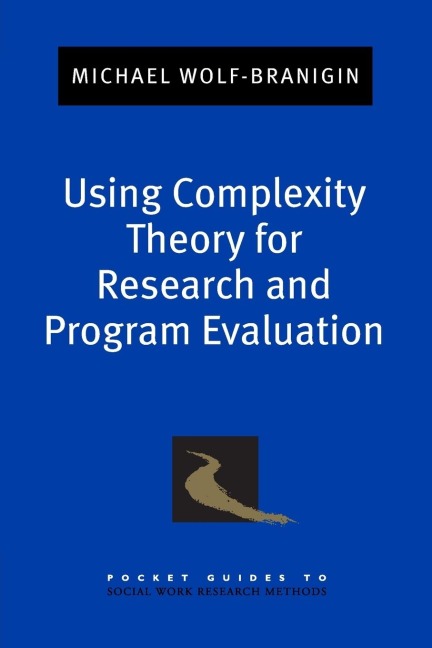
Using Complexity Theory for Research and Program Evaluation - Michael Wolf-Branigin
-25% koodilla BOOKS
Toimitus 15-21 arkipäivässä
30 päivän palautusoikeus
Complexity as a paradigm has been underutilized by social work, but this cutting-edge pocket guide makes a convincing argument for its use. Every agency worker has been faced with a deluge of records, making it difficult to grasp onto structures and trends undergirding behavior. Complexity theory studies the interactions of competitive and cooperative tendencies of agents such as individuals, families, grou ... Täydellinen kuvaus
Saatat myös pitää
 TOP
TOP

The Demon-Haunted World: Science as a Candle in the Dark
-25% koodilla BOOKS
Toimittajalla varastossa
TOP

Heart Rate Variability: Science and Strategies for Peak Performance
Marco Altini, Sylvain Laborde, Dan Plews, Emma Mosley
-25% koodilla BOOKS
Loppu
TOP

Many Faces, One Purpose: A Managers Handbook on Women in Firefighting
U. S. Fire Administration, Homeland Security
-25% koodilla BOOKS
Loppu
TOP
The Gulf Moment: Arab Relations Since 2011
Florence Gaub, U. S. Army War College, Strategic Studies Institute
-25% koodilla BOOKS
Loppu
 TOP
TOP

Introduction to Algorithms
Ronald L. Rivest, Charles E. Leiserson, Clifford Stein, Thomas H. Cormen
-25% koodilla BOOKS
Toimittajalla varastossa
TOP

Thinking in Systems: International Bestseller
-25% koodilla BOOKS
Toimittajalla varastossa
TOP


Integrating Special Forces and the ATLAS Network: A Theoretical Framework for Strategic Security Cooperation in Europe
-25% koodilla BOOKS
Toimittajalla varastossa
TOP

The Code Book: The Science of Secrecy from Ancient Egypt to Quantum Cryptography
-25% koodilla BOOKS
Toimittajalla varastossa
TOP

101 Things I Learned in Architecture School
-25% koodilla BOOKS
Toimittajalla varastossa
TOP

Skin in the Game: Hidden Asymmetries in Daily Life
-25% koodilla BOOKS
Toimittajalla varastossa
TOP

Dinosaurs and Prehistoric Life: The Definitive Visual Guide to Prehistoric Animals
-25% koodilla BOOKS
Toimittajalla varastossa
 TOP
TOP

International Economics: Theory and Policy, Global Edition
Paul Krugman, Maurice Obstfeld, Marc Melitz
-25% koodilla BOOKS
Toimittajalla varastossa
TOP

The Unaccountability Machine: Why Big Systems Make Terrible Decisions
-25% koodilla BOOKS
Toimittajalla varastossa
TOP
Nudge: Improving Decisions About Health, Wealth and Happiness
Cass R Sunstein, Richard H. Thaler
-25% koodilla BOOKS
Varastossa
TOP

Crossing Borders: About the birth of the Consortium of European Research Libraries, the organisation's early years and its path to maturity, spanning the period from the late twentieth century to the first decades of the twenty-first century
-25% koodilla BOOKS
Toimittajalla varastossa
TOP

Cybernetics: Second Edition: Or the Control and Communication in the Animal and the Machine
-25% koodilla BOOKS
Toimittajalla varastossa
TOP

Only Dull People Are Brilliant at Breakfast
-24% koodilla BOOKS
Toimittajalla varastossa

Kuvaus
Lisätietoja
| Kirjoittaja | Michael Wolf-Branigin |
|---|---|
| Julkaisija | OUP US |
| Julkaisuvuosi | 2013 |
| Kannen tyyppi | Pehmeäkantinen |
| EAN | 9780199829460 |